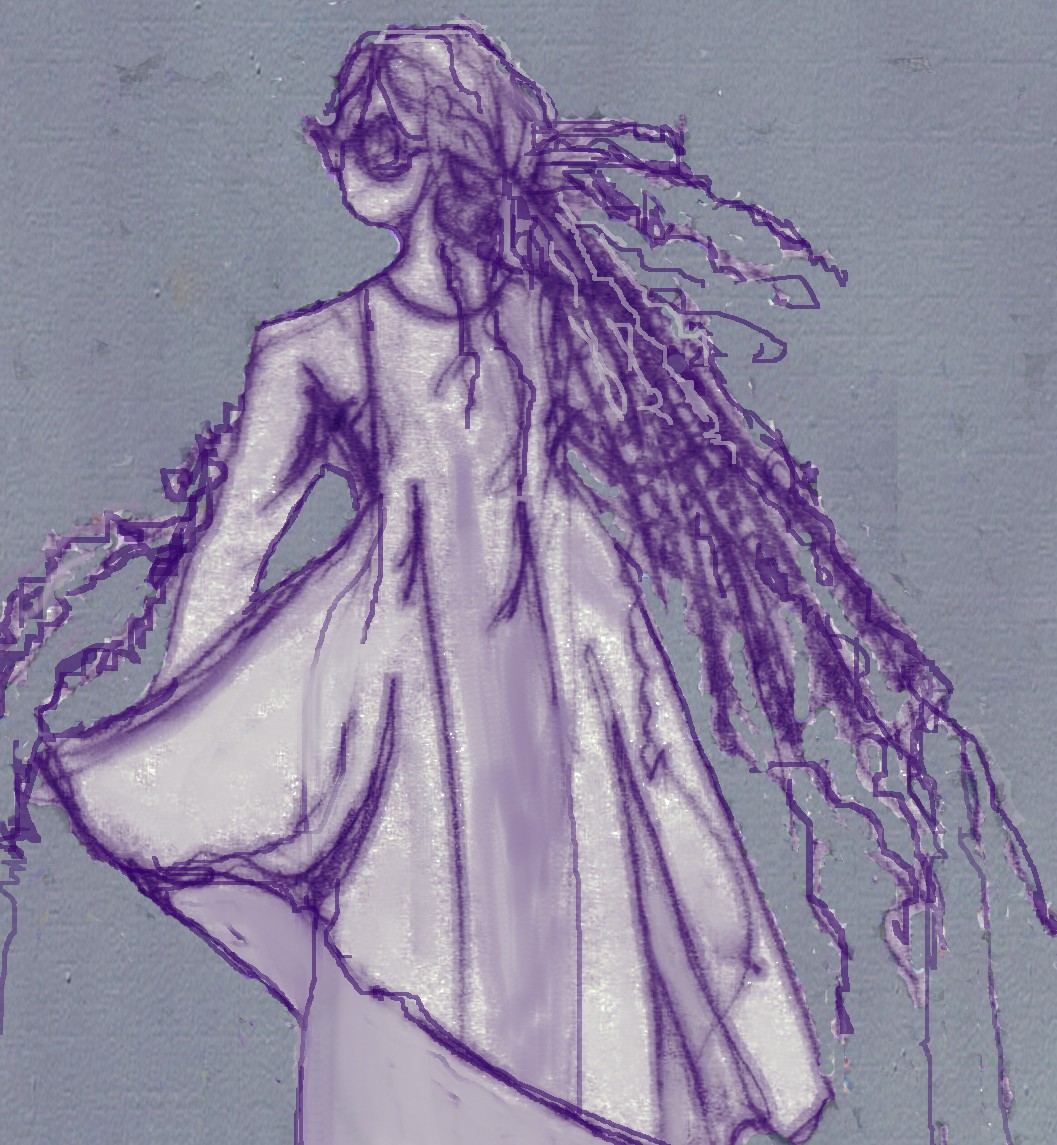
My writing process changed my narrative perception. My initiation, like most writers, began in early childhood education. We are given linear texts to map our developing minds. Our first readers are cogs in the socialization machine. Our eyeteeth cut on the expectation for Aristotelian narrative convention. I love to read and write plot-less narratives.
The past four years have liberated my writing from the conventions of fiction. Woolf’s essay, “Modern Fiction,[i]” reinforced the epiphanic moment when I learned women (brave) don’t write plot (this needn’t be gendered).[ii] The discourse on women’s writing and plot informed years suffered in workshop critique, and rejection. I realized early in my nauseating initiation into writing how poorly class, gender and generation had equipped me for the arduous task of becoming an author.[iii] The Beginners Comic Books, literary theory Dick and Jane type readers, opened thory’s complexity. Literary theory, often disparaged, shapes my narrative perspective. My solitary autodidactic experience failed to quell my desire for a MFA. The mirror reflects the background, not only what is held in front of it, even the gaps, completing an undergraduate degree seemed like an impassable crevasse until I rode the web to Goddard’s low-residency BFA program. Linearity on the page was a circumnavigated experience.
I only have to complete my creative thesis (novel in progress) to be receive my MFA (The City College of New York). My process was blindsided by my older of two brother’s catastrophic brain bleed. He continues to recover thanks to and despite the healthcare system. He has fallen out of the quotidian linearity he recently described in mind numbing sequence begun each day with the alarm clock set five minutes fast going off at 5:13 a.m., shower-shave, drive to the station, taking the same seat, talking to the same people, his egg white omelet set on the grill as he walked into the same diner, coffee break at 10:10, lunch at 12:40, card game with the same guys on the 4:45 back to the car parked in the same spot and home again. Is it any wonder he loved to read science fiction?
I have rambled to my obsession with writing, my own and others. My brother’s tragic case represents the danger of imposed conventions. I neither want to trivialize or minimize my brother’s event by comparing it to writing. His illness, entwined with my every waking moment pushes against my process actually altered my course, found its way onto the page. The association of everything to writing opens new ways of seeing, not material to exploit, to influence narrative representation. Fiction’s imposed conventions and constraints can form a block that like routine need release. I question as reader/writer how this is represented on the page.
[i] Look within and life, it seems, is very far from being “like this”. Examine for a moment an ordinary mind on an ordinary day. The mind receives a myriad impressions—trivial, fantastic, evanescent, or engraved with the sharpness of steel. From all sides they come, an incessant shower of innumerable atoms; and as they fall, as they shape themselves into the life of Monday or Tuesday, the accent falls differently from of old; the moment of importance came not here but there; so that, if a writer were a free man and not a slave, if he could write what he chose, not what he must, if he could base his work upon his own feeling and not upon convention, there would be no plot, no comedy, no tragedy, no love interest or catastrophe in the accepted style, and perhaps not a single button sewn on as the Bond Street tailors would have it. Life is not a series of gig lamps symmetrically arranged; life is a luminous halo, a semi-transparent envelope surrounding us from the beginning of consciousness to the end. Is it not the task of the novelist to convey this varying, this unknown and uncircumscribed spirit, whatever aberration or complexity it may display, with as little mixture of the alien and external as possible? We are not pleading merely for courage and sincerity; we are suggesting that the proper stuff of fiction is a little other than custom would have us believe it.
[ii] A women’s poetics, therefore, may have to reconceive the notion of plot as a fundamental aesthetic category so that it may be grounded in an idea of temporal order more appropriate to the cyclic experience of women’s lives. (Josephine Donovan, “Toward a Women’s Poetics”)
[iii] “A writer is expressing, and an author is communicating.” Richard Nash replied to Gabriel Cohen’s question, “What is the difference between a writer and an author?” (P&W, Nov-Dec 2011)
 Interactive intertextual narrative