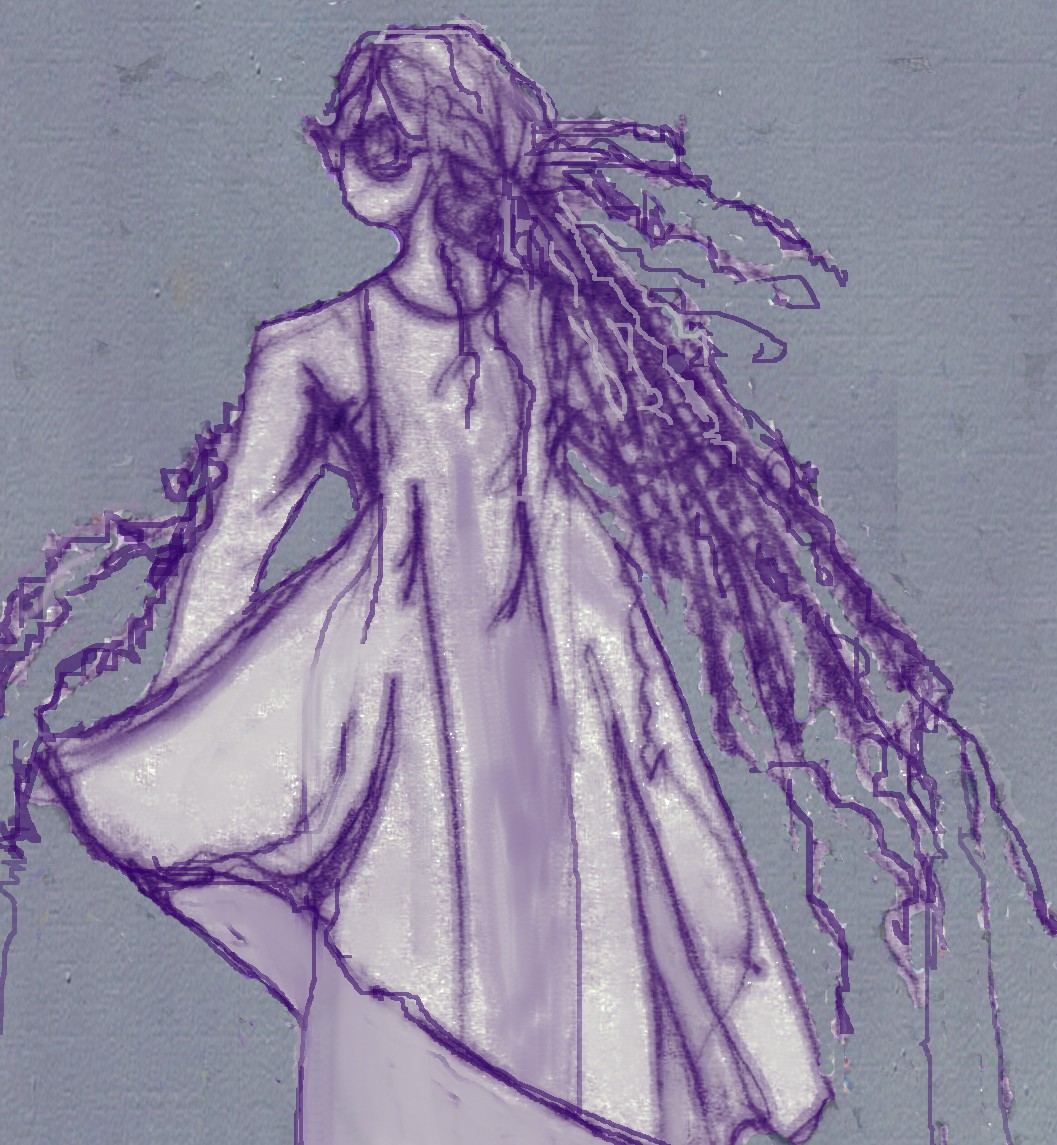
GROWN IN CRACKED TURF

Standard


         Janet and Louie kiss under the tenement lined street. The sliver of daylight falls between the cellar doors onto the top steps. The metal rattles when someone passes on the sidewalk overhead. I kick a loose clump of cement with the toe of my saddle shoe. My mother keeps an eye on Janet while her mother is at work. I am sent with Janet wherever she goes: to the corner grocery, the candy store, not the cellar. Janet and Louie kiss in hidden places. Other girls sit in their boyfriends’ arms on the stoop; some make out leaning against parked cars. Louie presses Janet against a metal pole, his thin black moustache covering her pink mouth. I wait on the edge of their shadow, afraid of the dark and worrying what my mother will do when she finds out. I tell Janet we have to go. Her voice sticks in her love-soaked throat. Janet and Louie kiss. Strange odors seep through the timber where a bodega has taken Chigimara’s spot. Green bananas and rice sit in the windows that use to be stacked with macaroni in blue boxes and cheeses hanging from string. 
         Janet and Louie do not speak in rhyme. She does not whisper poems to him from her fire escape. Janet and Louie kiss in the dark with cloth tongues, scuffling feet, shushing and the scurry of rodent claws. Sister Mary Francis has told my third grade class that kissing is a sin. She said God blocks the light from reaching the fiery pit of hell where sinners are damned for eternity. I can imagine heaven and hell but not eternity. Janet and Louie kiss goodbye. Janet grabs my hand, holds on tight as we stumble up the wooden stairs and go out through the door in the back of the hall. After she brushes cellar dirt from my navy blue uniform, she tucks her blouse into her skirt. Her hands shake and her voice cracks. I cross my heart and swear not to tell. Janet fears what will happen if I do.
         Our mothers are neighbors. Janet’s mother comes home to her only child smelling of cigarette smoke and liquor. My mother does not drink, but she lives with her boyfriend. My two brothers and I cross Second Avenue to see our father. He works two jobs to pay for child support. My mother’s apartment is on the top floor of a six-story walk up. She moved up a flight after she told my father to leave. Janet lives with her mother in the apartment at the far end of the hall. The steps next to our apartment lead to the roof. The metal door, always open a crack, is on the last landing that smells ashy, is out of bounds, and forgotten. The roofing glistens like black sand in the hot sun that melts the crooked tarred seams. My mother and I found a bottle cap and needle on the landing. She told me that if I ever take dope she would beat the hell out of me. 
         Our apartment is in an alcove between two other doors. Thick coats of paint smooth the beveled edges on the three panels. The banister’s dull sheen is tacky where dripped paint has hardened into beads. The hallway walls are queasy green.  My stomach hurts on school days. The nuns damn me for my sins. They tell me the devil can disguise himself as Jesus. If I trust him he will lead me into temptation. Louie has olive skin, a thin moustache and he looks nothing like the Jesus or the devil, yet he tempted Janet into sin. My mother pumps me for information on how this happened.
         Where did you see Janet and Louis kiss?
         On a park bench on the East River Drive under a scrawny tree.
         Where else?
         In the dark cellar under Louie’s building.
         What did you see?
         I saw them kiss.
         Are you telling the truth?
         I swear.
         What happens to girls that lie?
         They live in eternal damnation.
         I cannot explain to her how kissing put a baby in Janet’s belly. My mother’s shouting and my crying bounce off the hallway tiles, out the window, and down the six flights of stairs. The yelling begins again when Janet’s mother gets home. My mother hits me, not for the first time—it is her only defense. She tells me never to bring her home a surprise package. I remember how scared she got when our cat brought home a mouse and dropped it at her feet. The smell of damp concrete is still in my nostrils the next Saturday when I go to confession. Father Julian tells me to say ten Hail Marys and five Our Fathers for lying to my mother while I kept Janet’s secret. My penance wipes away my venial sins. Janet’s surprise package will need baptism to wash away its mother’s sin.   
         Kiss, kiss, kiss, kiss like the white stripe of paper curling from a chocolate Hershey. Janet and Louie kissed; a baby is on the way. Janet’s white fifty/fifty poly cotton blouse pulls and gapes at the buttons. Afternoons spent in the dank cellar have fattened her thin body. Janet’s mother wipes the floor with her trying to get rid of the baby growing inside her bellyful of kisses. Janet wants to jump off a bridge even though she knows there are no bridges on 119th Street. The East River lumbers by the metal railing embedded in concrete. Dry grass breaks through the cracks in the ground around green splintered park benches where Janet and Louie kissed under the scrawny tree. She does not climb over the railing to jump into the green currents. She does not walk up the flight of stairs past the syringe and cap to jump off the ledge around the tar beach. She does not go under a butcher’s knife. Janet waits. She waits at the top of the staircase for her mother to reach the last landing. Her mother calls Louie a spic and curses him for knocking up her daughter. Janet watches her mother rest her heavy body against the wood frame of the large window. There is one window on each landing overlooking the courtyard. The dishcloths Janet put out to dry after another meal alone hang limp from splintering clothespins. Janet leans her fetus half way out the window to watch the clothespin she dropped land on shredded brown grocery bags. Her mother stumbles up the five remaining marble steps with worn edges translucent as the plastic mother of pearl pin on her housedress. Greasy clumps of black hair stick to her swollen face. Janet waits a long time for her mother to reach the top step.
         Janet serves her mother a pork chop with cold spaghetti. She braces for the slaps that comes when inside her mother’s reach. I close my eyes until the dull crack fades. I hear her yelp as if the blow was to her stomach. She drops the plate and grabs her belly. Shards, sauce, chop, tangled in spaghetti streamers crash on the floor. Her mother’s hands on top of her own move around Janet’s round belly as if spelling out the answer. I run across the hall screaming to my mother for the help I think Janet needs. She is half way down the long foyer in our apartment when I burst through the door. She turns me around pushing me ahead of her. I hear her count off the months since Janet’s belly bloomed in last May’s sunshine. All through June, July, and August I overheard my mother, her friends, Janet, and her mother talk about what to do. September comes in through the open window on the landing it still feels like summer even though school has begun. My mother tells me the baby isn’t due for another two m
onths. Janet says she felt a kick. This time her mother does not say it’s gas. This time she agrees Janet must marry Louie.  


FALL 2008 – Ozone Park Journal 

The Walk

Standard

Bougainvillea cascades to the ground like origami folded love letters. A turn taken from my usual path, pass the gates of the Jewish Ghetto, through Campo Dei Fiori, down the street of shop windows displaying, shoes, clothing, and chickens dangling from metal hooks. Not lost, never lost, just not advancing. No longer a tourist, my visa expired, wandering, not noticing street names. My Italian teacher, the guy subletting my apartment, and some of my friends, had given me telephone numbers. The names are written on a page torn from a yellow legal pad. I call just to hear someone say my name. Millet. I have almost stopped calling the man whose letters had arrived at my New York address, stamped posta di aria. Pronto? I am not ready. His mother answers the phone, when he is home, she shouts, e´ La Americana. I crossed an ocean to keep our date, when he finally showed up three weeks later, we went to a restaurant. I asked for cheese on my seafood pasta. My vowels were too round. I guess I sounded better on paper. The last few times I called the mother snapped fuori, and hung up before I could ask when he would be back. Hope is more tangible went absent.
The ache spreads across my shoulders. A splash drops on my forehead, two more follow, and, a few splatter on the ground. A narrow swatch of blue squeezed between rooftops. A worn housedress, and two dishtowels, hangs from plastic clothespins, immutable female narrative drifts out of open windows. E´ora di pranzo, spoons, knives, and forks jangle, places set like fate. I move out of the line of water dripping off the edges of daily life.
November sun on a sea of cars parked counter-clockwise around the compass. Home, six hours behind under down quilts. A fresh turkey, and vegetables with native soil clinging to their roots, the ingredients for the cold antipasto wrapped in white deli paper, two pans of eggplant parmigiano covered with aluminum foil, wait in the refrigerator. A car door slams. Shut. The exchange rate for one year of yearning is months of displacement.
Rumps of prosciutto crudo, and cylinders of provolone. The alimentario passes a sample on a sheet of glassine paper over the counter to his last costumer. She rolls it between her fingers, chews and nods approval. Twists and turns the streets backtrack on each other, and the Bougainvillea more orange than at first sight. The clash of a gate falling to the ground scares off stray cats and the epic dead. The alimentario stoops to insert the padlock into kissing eye rings. Signor. Shoulders bent in professional servility, he says mi dica, as if it is my turn to order an eto of salami, and a rosetta roll. Dove´ Il Pantheon? He slices the air, his hand waving to a spot down the block. Diritto. With his other hand bending side to side. Destra e´sinestra. Diritto? Straight. E´ destra? Then right. He gestures for me to follow. His indigo cardigan stretched at the hem, elbows on the verge of threadbare. 
The alimentario enters an alley. A woman rushes past, a blue plastic shopping bag in her hand, the unmistakable aroma of restless lovers. Her face carrying feral passion. Ore di pranzo, divides morning longing from aching commitment. In her kitchen she rubs pink plump wrists like chicken cutlets with garlic, dips Judas fingertips into fresh ground coffee, and gargles with lemon juice. She points to the steaming pot when her husband asks why her cheeks are flushed? Constantine—Frederick—Victor—Benito, tucked away until she hears sleep’s rhythmic breath beside her in the dark.
The alimentario calls to me from the shadows. Prego. Footfalls ricochet off moss-stained arches hording daylight in overgrown ivy. My rubber sole shoes pass iron bars exhaling martyrs’ prayers. The breath rising from buried cities wraps around my bare ankles. Never hearing of something does not mean it has not happened. Many things menace a woman alone. Flesh decaying like a leper’s, bones sealed in contradiction. Who could know? Happiness has restrictions; loneliness is limitless.
The alimentario stands aside to let me pass. Prego. He enters a courtyard some feet from the exit. Sunlight inches closer to the oculus, brushes the Pantheon’s bruised hide scarred by time and plunder. Shop windows, unfazed by tourist activity, doze in communal nap. The street performed tuning his guitar eyes the lire coins scattered in the opened case on red velvet. A few yards away, a girl sits on the pavement, a toddler to her flaccid breast. Her free hand held palm up. Prego. Prego.
Monuments adapt.
I check my wristwatch like a mime imitating someone in dark glasses late to an appointment. Millet. Millet. I look around to see who called out my name. I see no one I know except the fountain’s stone eye leviathans spewing recycled sighs. Chatter between mouthfuls, metal tapping ceramic, and the silence of lips on glasses, hum a familiar tune. I find an open table under the canopy of umbrellas, and take the chair best situated to view people, columns, pediment, the obelisk out of focus. Lei sta sola? The waiter grumbles about three empty seats. He recommends gnocchi. I order vino bianco. It is Thursday. The alimentari close for the afternoon; fresh gnocchi is on the menu. Mythical roots, the fifth day of the week, potato and semolina dumplings. I will move beyond repetition when the simultaneous translator no longer intrudes.
The waiter pours wine, di consumo, I will be charged for the amount I drink, more than a glass, less than a bottle. Does it take centuries to figure out elegant solutions? Prego. I take a gulp, wine the color of harvest spreads from my mouth to my shoulders. I check the time on my wristwatch. I count back six hours to home. My sublet will not deposit the last two months rent into my account for at least three more hours. My yearning spans the Atlantic Ocean.
The fountains steps rimmed with crowds, tourist, workers, and pigeons pecking the ground for panini crumbs. A couple in matching blue bandanas, printed with white paisleys, backpacks at their feet, lean into each other. She takes a bit from his sandwich. He tries to snatch it back. Thick braids tangle with his long hair tangle with crusts and lips. 
Scented steam rises from the dish put in front of me. The waiter sprinkles parmigiano; it falls like snow on wind-bent branches. He lingers. Wine gone to my tongue, ho fame—lo so. Tutti hanno fame. I take the book from my bag, open to the marked page. I prefer the company of characters, loose ends of messy lives bound between two covers. Miniature bits of gnocchi, between paragraphs, melt like the Eucharist on my tongue, wine between each sentences; enjoying morsels of community. A pregnant cat rubs against my leg. I have an idea to rescue one of the dozens of stray kittens, maybe two, nothing enjoys constant solitude, and sneak it into my room rented by the week.
Lethargic, and cleansed, my body longing, the sheets on my twin bed washed in disinfectant detergent. The blanks walls demand answers. The afternoon sun outlines the shutters with promises that keep me here. I have met the couple next door in the hall. The women’s cautious smile parts her the blue henna tattoo. Emigrants wait in Rome for U.S. visas. I have an American passport, so what am I waiting for?
Stained-rim glasses, crumb-scattered tablecloths, and crumpled napkins, the chairs askew, metal shutters wake making a racket. Ore di pranzo e´ finito. Crosshatch movement flows in entrances and out of exits to the piazza. Snatches of Lay Lady Lay and mother’s lament on, coins dropping into soft pile and extended palm. Romans arms linked, holding hands, stroll somewhere at the pace of the stories they exchange. 
I gesture for a check. The waiter out of uniform, his pleated cummerbund removed, points to a man alone at a table in the next restaurant. E´ja paguto. Musk scented armpits, and lust locked seams. The bottle empty, my glass nearly. I nod and walk out to the piazza. My head burn
s from wine turned to vinegar. His gaze follows me. I fill my hand with water from an open spout, resting it at the back of my neck. A few drops trickle down my spine. Pigeons peck at a blemish on a gargoyles stone cheek. An Asian girl peers into the camera viewer coaxing her lover to smile. He mugs. She laughs. They ask me to take their picture using the Italian word they think means everything. Prego. Through the viewer all couples in love are alike, intimate and awkward. I hand her the camera. In the end who will keep the photo, and who value it?
The empty tables are set with white over burgundy, green, rose, blue. Fountain utterances. I touch my damp collar, looking directly into the lens I say. Cerco mi stesso. The English subtitle translates, I am looking for myself, intp I want anonymity. He walks away. I move in the opposite direction, wanting shelter from the glare coming on the tepid water.
Nylon warm-up suits, and camera shutters whisper like sighs through the portico. A bent zitella, better acquainted with the recent dead, seated in a chair beside a column, sells lotto tickets. Cataracts veil her vision. Fortuna. Vente milla. Fortuna. Her voice vibrates like wind through a hollow reed. I move closer for a better look at luck. Close enough to smell the woman’s ripe age. Zitella. The old woman lifts her head out of its curved spine. Fortuna. Vente milla. One, please. Che dici? Uno. Grazia. Bona fortuna.
Arm in arm with luck accompanying me through late day shadows, along random streets that lead away from tourist clamor. I stop into a bar for an espresso and a gitone to make a call. I drop the half-dollar size coin into the phone box at the back of the bar. My finger dials his number, an involuntarily reaction learned from a lifetime of bad habits. Embarrassed, and gangly emotions, deluded by illegible handwriting. 
The bleating of sheep, death in their nostrils, murmurs of entreaty rising in the cavernous marble womb, lost in hollow coffers. Silent repetition seeking someone divine to listen. My words fall back into my mouth. The silence should have hurt. The pause instead, like a brief respite in cicada orgy on summer night, wakes me. Chi e´? Nessuno. Done. Tutti hanno fame—everyone has hunger.
Signorina, voi qualche cosa?
Prego.
For me?
E´ bona fortuna.
Bougainvillea cascades to the ground like origami folded love letters. A tabby kitten, one eye sealed closed. Pronto?

STEM STELL RESEARCH

Standard

An egg is not a life. An egg has the potential TO BE a life as does the chicken egg you fried-scrambled—poached—boiled and drop on the floor most mornings (before the salmonella recall) could have been a chicken, the veal chop you had could have been a lamb, the hamburger you had was a living breathing—methane polluting cow with calves. 

Had God been created in the image of a chicken, lamb, cow would humans be feed?

An embryo may contain the POTENTIAL for life but cannot live—even with great medical intervention outside a woman’s womb. Do deceased humans deserve to live at the expense of a potential life? It may be all about karma or it may be all about life. No matter, however an egg is a potential for life and once we accepted freezing and storing embryos we slid down the slippery slope. Now all these dozen eggs are spending existence in a freezer waiting for a womb—seems like rather than trash the potential it is better to save a living—breathing—human. The rest is politics. 

SEASONABLE DESIRES

Standard

White Cotton Shirt

She picks a peasant shirt from the rack and looks for her size. There are 2 smalls, 3 larges, and 1 medium. Her fingertips pass over black paisley embroidered borders. The hanger dangles over her arm like a compass pointing southeast in the direction of its country of origin. She slides her bra straps off her shoulders, unties and reties the ebony satin ribbon into a bow. Spring ahead, longer daylight hours, summer not far off.

Did you find what you were looking for? Russian or Eastern European accent, to her ear both sound similar. Only the shirt, for now.

She gets into the Japanese hybrid redolent with cumin, cardamom, turmeric, and sumac. The driver’s lunch, half-eaten, in a foil puddle on the front seat beside him. Her destination given (forty-fourth and second) she repeats it in single digits, 4-4—and 2.

Argentinean Malbec bought at the liquor store a block from her apartment. She buys Italian Gorgonzola (dolce), Greek olives, and sundried tomatoes in Tuscan olive oil from the gourmet grocer next door, and stops at the Korean market on the corner for baby lettuce, and blueberries imported from Chile, a container of milk. A north wind off the Hudson; winter still hangs on.

She puts the bags on the glass top table. Uncorks the wine, shakes the baby lettuce into the salad spinner, the blueberries in a bowl. She lays the white cotton shirt embroidered with black paisley borders and ebony satin bow wrapped in tissue across her bed.

Washington Square Park

The cloud hovers in a space between treetops. The cloud hovers on top of a building with a red tile roof. The cloud drifts lazily in the breeze touching her arm. A cloud between treetops, over a building with a red tile roof, leaves lush after a rainy spring—verdant at the start of a new season. Bird song, traffic slush, and children chirping—a breeze on her skin. Two women in black and white—the space between two strangers—almost astride, skirts dance around bare legs. One in a black dress beneath a white pinafore, thick straps crisscross at her back tie in a bow at her waist, a second behind, in a white sleeveless blouse over a black trumpet skirt, gussets fan open with her leg’s movement.

A red brick circle— in spots yellow tipped grass breaks through the cement mortar. A chick, a babe, and a girl sunbathe, lounge around the circle, roasting their flesh to a perfect hue, sits on blue jean legs eats crumbs from the bottom of the brown paper bag and reads—sits up, reties her bathing suit, tote bag on peach towel spread over red brick, rearranges the tote pillow, reclines—a straight leg flat to the ground, a leg bent at the knee, (stems), coral jean skirt, frayed hemline, black rubber sole flip-flops point north and south, head east, and body west, her fingertips travel her firm belly. Two leave. Tanning is tedious work.

The trees lush after a rainy spring—verdant in their infancy at the start of a new season before the onslaught of July and August heat. Bird song, traffic, voices of chirping children carried on the breeze. Dope dealers, chess players, and rats in the vegetation around the brick housed public bathrooms. Aware of my surrounding—never let my guard down—I am a New Yorker.

Six Floor Walk-Up

She sits at the open window. A rind hangs from her hand. Pulp—red and fleshy—slips from her chin onto the front of her white t-shirt. Black seeds (watermelon) drop to the street below. Kids in bathing suits splash in hydrant surf on asphalt sand. 

A Fish Story 

Day slips into dusk. The air turns cool. She walks along the shore, her face damp with fog. A dark shape huddles close to the dunes. Driftwood dragged off the beach, chained behind a pickup truck and set on a deck. Buff skin like chamois. Tree trunks churned in ocean waves and sun bleached, wind silenced in absent branches.

Wind through the hollow trunk—nothing more. Day after, Labor Day, sea glare blind windows squint into the thickening mist. You know how she responds. So much had happened, if not to her then to other women. A gust lifts party streamers like Isadora’s chiffon scarf tangled in spokes. She moves without hesitation.


February 20, 2010 Ragazine.CC

Deborah Di Bari is pursuing a MFA in Creative Writing at CCNY. Her narratives have appeared in Ozone Park, and Guideword. She is a not so recent transplant from the design and fashion worlds. In her search to merge tense, she is pursuing an investigation of hypertext through the artist book.


BABY, WOULD YOU TAKE THE BULLET FOR ME?

Standard

1

Time had run out. Decked by hubris, Admetos dropped on the mattress. Comatose from too much champagne? He had had much to celebrate these past years. A new pregnancy had followed the birth of a son. The girl was born before the boy’s first birthday, with another possibly on the way. Alcestis’s breasts had been giving milk as her belly transported his heirs.

Her arms, marble to his touch, clutched her knees. Dawn tinted the windowpane pink. Sunrise sculpted the nightgown to her body. Nothing would go with her. Alcestis, rigid with resolve, did not wake him. Apollo agreed to come after lunch. She had found a volunteer.

One morning, Apollo came to visit. He stayed in the guesthouse. Apollo was doing time for murder. The jury of his peers had given him a lenient sentence for the revenge killing of the lackey that had killed his son. The order came from the top. His son had raised the dead from gutters and shelters. His son’s words had healed wounds of despair. The gutters and shelters emptied. The authorities attempted to close down his son’s private, no-fee clinics that distributed condoms, abortion, wellness, and socialist theories. Voter rolls swelled in the lead up to state-controlled elections.

The news had come in fragments. Multination. Pack of Rottweiler. Lone wolf. Dead at the age of twenty-nine. Healer. Radio, flat screen TV, print media, already gone to press, sent e-mail alerts to subscribers.

News Alert

02:30 AM EST Thursday, December 3, 482

Asclepius, son of oracle god Apollo, dead after dog attack outside lower eastside clinic

Asclepius was said to have been raising the dead in the name of the father. Unconfirmed reports say his powerful grandfather, Zeus, arranged the attack as a last resort to hold onto his power over life, death, and conception with mortal women.

Talk radio proclaimed Asclepius, the leader of the Medusa blood cult and child molestation, had been murdered during a homosexual rendezvous. The tabloids inflamed opinion at supermarket checkouts until her decision became the news.

Evidence showed Apollo had flown across the globe, gathering information along the way. He then took the car, waiting on the tarmac at Kennedy International Airport, to the dog trainer’s home. His trademark gold tip arrows were found in the bodies of man and beasts. Apollo was given seven years of living and laboring for a mortal. A boy sponsored by one of the few remaining immortals, Admetos had been the last to arrive at Alcestis’s bridal games.

Her blood scent carried on a downdraft. The suitors howled. His doeskin boots crumpled around his ankles. Alcestis’s father doubted Admetos’s ability to protect his company from hostile bids. A hostile take over from North or South could change his status from CEO to criminal. June breezes carried sweat and musk high up to her loft. The unmistakable fragrance like the stallions in father’s stable aroused her ambivalence. Alcestis stumbled from bed to balcony. She reclined on bed and chaise, hearing her mother’s sibilant Alcesstissss blowing through the women’s quarters. She watched the negotiations on the closed-circuit monitor in her sitting room. North, bent by frigid blasts had years on her father. South frisky as a cub intoxicated on male pheromones. East lumbered on feet tick as bacon slabs. West, yes perhaps, West could have done.

How long before another marriage to a prominent man cut short her grieving? Lands are wed. Women were conveyances, voluptuous, fertile vessels of hope. She had gyrated in her father’s orbit. Sitting on his knee, she watched his mouth shape her fate. His finger pressed to her lips had silenced her protest. Alcestis, your marriage will form a powerful business alliance. Everyone will benefit, even you.

Her husband’s exhale splintered his rib. The jagged bone grazed his lung. Death’s finger poked beneath his plump feathers. The conference of practitioners sent an envoy to deliver the final verdict. His time had come. A volunteer had to be found sooner rather than later. Admetos, struck by his immortal patron’s limitations, had petitioned the two people certain not to refuse his request. He selected two hourglasses from his collection. Gold to represent his father’s age; the piece with pearl encrusted handles, his mother’s. The hourglasses’ upper bulbs three-fourths and two-thirds empty sat beside an egg timer. Everyone understood the plastic kitchen timer’s meaning. Clenching life’s pinky finger, both refused the voluntary opt-out. Alcestis reached for the ticking egg timer lying in the sand at her feet. Her earring moved by the whisper blowing at the back of her neck. Through the humid night, her head down on her knees set in stone. The rescued man slept. His doeskin boots limp in moonlight and starlight. After his death, what would remain? Admetos in a grave…

2

Paparazzi cameras whir and clack. Flashes illuminate silent gaps. The pundits chatter pros, cons, and improbable odds. How far would she go? We’ll tell you more and give you the top stories we are following after this.

Erectile dysfunction and bladder control pharmaceuticals, a public service message about smoking, insurance, assurance, something to cure everything, all in slow motion perfection and a piece on the Mediterranean diet’s efficacy on longevity, the montage. Her image on the screen, markers of happiness and success pulled from the archives and spliced together: wedding day, childhood photo with her father, her infant son curled on pregnant belly, a family portrait with a toddler in each of their laps. The black-and-white, nude cover shot, the constant backdrop to speculation. The original sits on her dressing table in a borderless crystal frame. Backs to the camera, faces in profile, lips just about to touch, Alcestis mouth tilted up to his. The photo taken in Sicily hit the newsstands as they sailed in the Port of Volos.  

Breaking News: This from the news desk.

Death has arrived. Hold on, we have live video. Hank Lauders is just outside the gate of couple’s palace. What’s going on there, Hank?

Well, Fred. Just a minute ago, Apollo, on his way out to avoid pollution met at the palace gate. Apollo made a last-ditch attempt to persuade Death to spare Alcestis’s life until old age.

The two deities exchanged words. It looked for minute as if there would be a struggle. The authorities held back the crowds, and we couldn’t get our cameras close enough, but in the end it seems Death has prevailed for now. Death entered the palace. 

Scissors slice cloth and hair. Camera shutters blink open and close—grief at metallic speed. He stumbles loss-nauseated. Thick neck vessels on shorn heads, women in tattered garments, throats raw from lament. Her husband stranded with the living, follows her shrouded corpse.

What had made her do it?

What tipped her over the edge?

The children are safe, not like the last time.

Medea was a witch.

What is the story with these foreign women?

The dead are silent.

She had clothes and homes, everything money could buy.

She had a happy marriage. Had anyone asked her?

Ask Alcestis such a ridiculous question?

Do you ask the sky’s cloudless reflection on the calm sea if it is a lovely day?

She was lucky.

Burnt meat and lament—houseguests, pranksters, and demigods trample Alcestis’s flowerbeds.

Alcestis should have pitied her husband. She should have refused Death’s seduction.

Pity is what killed her.

Husbands will expect their wives to follow Alcestis’s example.

Baby would you take the bullet for me?

See what I mean.

Breaking News: This from the news desk.

In what appears to be another bizarre development in Alcestis’s ever-evolving and bizarre story, it seems Heracles, the famed Gold Medalist, showed up unannounced some hours ago, after the funeral. Sources close to the grieving family have said The Gold Medalist disappeared after one of the staff confronted him for defiling Alcestis’s memory with his drunken revelry. Ah, Hank what can you tell our viewers about this strange twist?

Ah, that’s right Frank, the Gold Medalist showed up about an hour after Admetos had returned home from the gravesite. My sources say Admetos, caught between grieving and hospitality codes, had not revealed the true identity of his deceased. The Gold Medalist believing it some foreign staff member, went to the recently vacated guesthouse where Apollo had stayed in exile, if you remember, and well partied in the manner he is famous for.

Ah, Hank does anyone have any idea of the Gold Medalist’s whereabouts? Is he—

Hold on Frank, we have just gotten word the Gold Medalist has returned; this is really strange, with a woman?

The Gold Medalist leads a barefoot woman on a rope. Grave silent. The tattered and shorn chorus part. Admetos sits in the center hall cleared of mirrors and furniture. Apollo had served his time. Death had come and gone with his prize. The two had crossed paths at the gate. Admetos extends a hand to greet his guests. Here, she is yours.

What is this friend? Have you brought a gift? The chorus misses their cue. The digital clock ticks off the hours of mourning. His hands pried from her grave’s gate. He never asked her to die for him. He did beg for her to stay. Witness accounts are inaccurate.

Death cheated you my friend. You should not have allowed me to stay. You said your mourning was for the Mexican babysitter.

How could I say I buried my wife? I had mastered the words when you arrived. I know them now. Alcestis is dead. Apollo failed to negotiate new terms.

I need a favor, can you give this woman a safe place until I return?

I just buried my wife.

This woman took the bullet for her husband.

Death has changed her.

And you?

Why is she silent?

She has secrets. Give her a few days.

Is she ill?

Time heals all wounds.

What do I say?

3

Early daylight shadows parade along the walls. She attracts the dead and repels the living. Resurrection confuses her senses. Sworn to newborn secrecy, words fall stillborn from her mouth. The dead do not come back, only the dead know why. Death stalks Alcestis. He clings to her in fragments after waking. Her skin chaffed. She melted in the glacial river. Death is greedy. He took the coin and hung the embryo from a branch to grow thick and sweet. Lava. Snail. Rabbit. One-cell existence. Unmade and made. Was someone calling? She wished the living would stop calling out her name.

Who invited him here? Had he come for a fight? Trouble followed the Gold Medalist like a shadow. He snatched her. A hairline crack—she dropped like a feather from Thanatos’s wing. She had barely tasted Styx water.

Stroke victims communicate with their eyes, one blink for no, and two for yes. No one dares to penetrate her silence under suffocating layers of white tulle.

Lament struggles with abrupt reversal. The doo-wop chorus cannot agree on the right note for resurrection.

C major.

Too light.

 C minor.

Too somber.

How’s this, Baby, come back.

I came back.

Forget.

I did forget.

Baby, would you take the bullet for me?

I did.

Alcestis is one of a handful of wives resurrected after death. If she can maintain her silence for three days, she will be the first to succeed. No one remembers rebirth. No one will attend to the resurrected. The two women famous for attending the resurrection call Alcestis a fraud. The cables soon drop the story; Baby, would you take the bullet for me? is last week’s lead. The new lead is the Gold Medalist’s world breaking downhill slalom against time. It has better visuals. The paparazzi decamped to the limelight.

Maia washes the oily milk coating Alcestis’s purple skin tinted green like autumn plums. She rubs at the stubborn love bite on Alcestis’s right shoulder. Her fingers tangle in Alcestis’s honey-mated dreads. Alcestis reaches in silence for the mementoes dropped on the floor. Admetos watching from the shadows reminds Maia of her cuckolded father.

Alcestis pecks like a bird, sparrow or chick at its shell. Maia slaps her hand worrying the hole in the veil. I see now where your toddler daughter comes by her willfulness. She pins ivy leaf brooches to the shoulders of vernal equinox voile. Alcestis, had she been able to voice her opinion, would have chosen bacchanal crimson to give her complexion a lifelike glow.

She is sitting in the sun beneath a gauzy canopy. Alcestis rocks her cradled arms side to side. Rills run from her frost caked lashes. Time passes, if it passes at all. Alcestis places her hand over her heart. Maia agrees to bring the toddlers when her color is brighter. Alcestis gaps with fragments she picked up. What came first her soul or body? What comes next?

4

Alcestis, was Death a considerate lover? Did you enjoy his caresses? Is that why you willingly went to him? You know I would have been fine if you had stayed buried like any other wife. I have kept my promise. No woman can ever replace my Alcestis, not even you. Admetos stamps out of the bedroom. He does not want to know about life after death. Since her return his doeskin boots do not crumple near her side of the bed in the moonlight and starlight.

Alcestis wakes in a parallel space, between tissue-thin barriers. His fear resonating through her bone, flesh, and sinew. Admetos had excited her girl hunger. No Goth girl chasing death, she just preferred the grave to another marriage.

Alcestis hides the chronicle of her death under the furs stored in cedar chests, in shoes and bags on shelves, and in closets of clothing. Husbands tend to destroy or edit their dead wives’ journals. She watches herself bend and stand and kneel in choreographed ritual. How else will her resurrection be complete?

She bangs her fist against the wall to show signs of life. Sheets scented with asphodel perfume. The sun rises. Her cycle spots the sheets. In her solitude, her room rises and drops with the rhythm of marching feet. Helen, radiant myth, squeezes Alcestis’s hand until the blood drains. She holds her free hand up to block the glare from the sea of shields, breastplates, and helmets. Helen’s husband ravaged Troy to reclaim her. Admetos eases his rigid body into bed beside Alcestis after sunset. She died for him. Now she must live for herself. Admetos’s index finger pressed to her mouth maintains her silence. Alcestis holds up three fingers. He folds one down each remaining dawn.

A yellow film floats on the claret’s surface. The second day after the accident, bile runs in thick black cords. In the middle of the third night she wakes in rush of sighs, sighs—suffocating sighs.

The expectation of her first words throws her home into chaos. The shorn and tattered women cover their heads with tulle scarves. They wash graffiti from walls and tear posters off official buildings. Baby, would you take the bullet for me? The women tell their husbands to remember. The men ask their wives to forget. Paparazzi, cameras, and sound equipment crowd the west gate.

The Pleiades point her to the hour. The heavens feast and mourn; someone has died, wed, a fetus breaks through luminous membrane. The resurrected dead are too few to number. Alcestis’s lips part. Her toddlers’ names balance on the tip of her tongue. Her voice returns on schedule. Words bruise her mouth. She finds a new way to use them. The sweetest morsels taste like alms. She names the world anew blue/tart, water/life, milk/contraceptive. Alcestis slips the last line she wrote in silence into the crystal picture frame on her dressing table. A mother gives her newborn the gift of birth and death. The first cry follows the last gasp.


PROMETHEAN: The Official Literary Journal of The City College of New York

Spring 2010 Volume 37